The Boxing Gym Reality Check: He Was Twelve Hours From Throwing the Fight
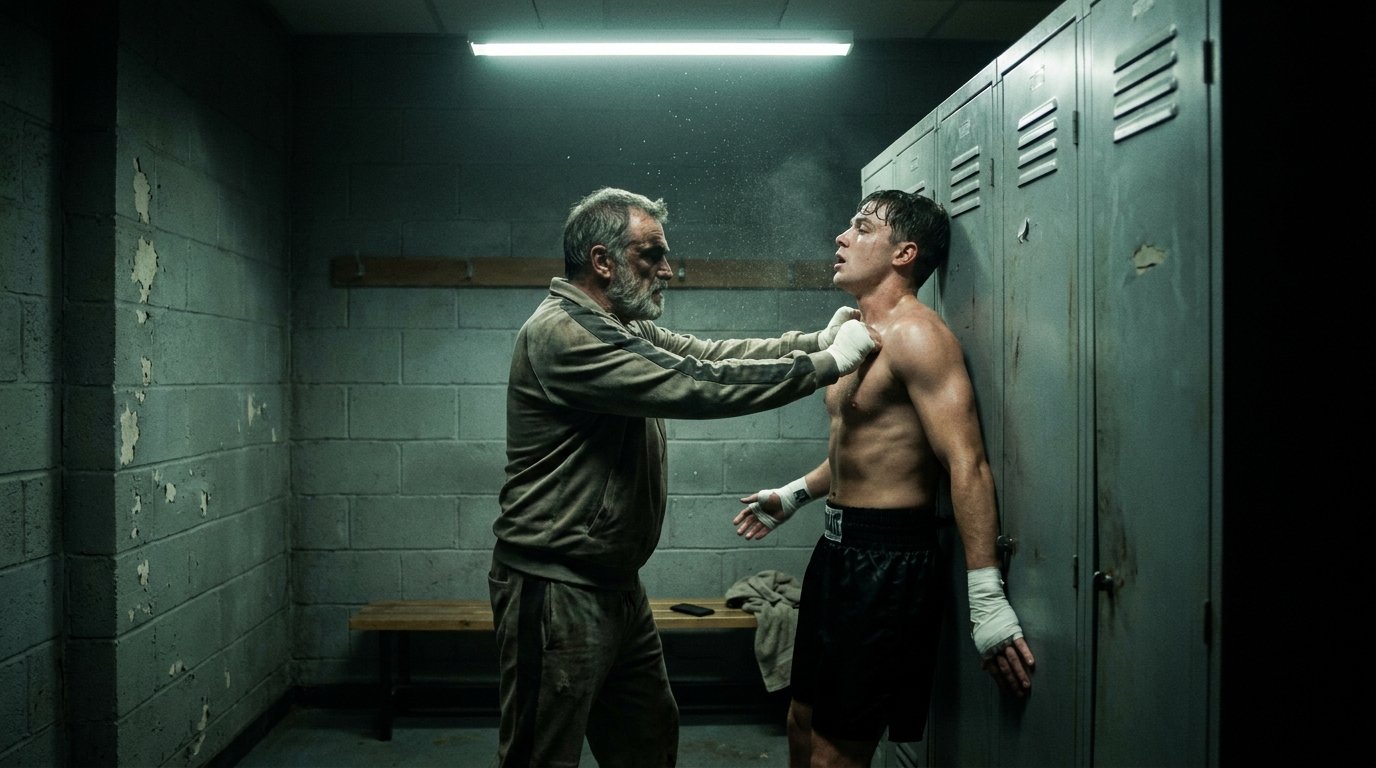
The locker room under the Sheldon Arena has no windows, one bench, and a light that has hummed at the same pitch since 1987. Fighters have been told they are finished in that room, and told they are champions in that room, usually within about ninety minutes of each other.
On the night in question it held two people and a phone that had already been answered.
Nine Hours Before
Elijah Boone was twenty-four and undefeated at seventeen fights, which sounds better than it was. Eleven of the seventeen had been carefully chosen.
He was fighting on Saturday for a regional title against a man five years older who had been stopped twice and who nobody in the building expected to last eight rounds. It was a step up. It was also, everyone agreed, a step he was ready for.
He had eleven thousand dollars in debt across three places, a mother in a rented house with a roof problem, and a purse of nineteen thousand before deductions, which would net him something closer to eleven after the cut, the licence, the medicals and the taxes he had not yet begun to think about.
On Thursday a man he half knew from a gym in another city had offered him sixty.
The Number
Sixty thousand to go down in the fourth. Not to lose — to lose in a specified round.
That distinction is the entire thing, and Elijah understood it perfectly well, which is why he had not said yes on Thursday and had not said no either.
He was saying it out loud on Friday night, in the locker room, to a cutman who had gone to get tape and to his trainer, who had not gone anywhere.
“It’s one night,” he said. “One night, and my mother’s roof gets fixed, and the debt’s gone, and I fight again in June like nothing happened.”
Cornelius Hicks
The trainer was sixty-eight and had held pads for four hundred fighters.
He had been a fighter himself, briefly and unremarkably, in the early eighties. He had eleven professional bouts and had lost five of them, and one of those five he had lost on purpose, in Baltimore, in 1993, for eight thousand dollars that he had spent in less than a year.
He had never told Elijah this. He had never told anybody except his wife and, once, a state commission investigator who did not have enough to do anything with it.
He came off the wall fast enough that the bench scraped.
What Happened in the Locker Room
He took hold of the boy’s collar with both hands and put him against the lockers hard enough to make the whole row of them ring.
He did not hit him. He came about as close as a man gets, and his hand was already up, and he has said since that the only reason he stopped was that he saw Elijah flinch — and that the flinch was the first honest thing either of them had done all week.
He let go of the collar. He stood there breathing like a man who had just gone six rounds and he said:
“Wake up. You’re a fighter, not a coward.”
Then he sat down on the bench, which is the part Elijah has always said mattered more, and he said the next thing much more quietly.
“And I’m not talking to you. I’m talking to me. Sit down. I’m going to tell you what happens after.”
Baltimore, 1993
He told him all of it and it took about forty minutes.
The money, which felt enormous and was gone in eleven months. The fight itself, which he described in unusual detail — the specific physical difficulty of losing on purpose to a man who is genuinely trying to hurt you, and the moment in the second round when he realised he could not simply fall, because falling badly looks like falling badly and men in a room somewhere were watching for that.
He described taking a right hand in the third that he did not need to take, because by then it was easier to be hit properly than to act.
He described the following two years, in which nothing happened at all. No investigation. No charge. No consequence he could point to. Just a slow reordering of who called him, who offered him work, and what kind of work it was, until he was thirty-one and cornering four-round fighters in leisure centres and could not entirely explain how.
And he described the part that Elijah, by his own account, had genuinely never considered: that the men who paid him did not go away afterwards. That they came back in 1995 with a different fighter and a different number and an entirely reasonable expectation, because a man who has done it once has already answered the only question they need answered.
“They didn’t buy a fight,” he said. “They bought me. Eight grand, and they owned everything I did after.”
What Elijah Did
He did not sleep. He got up at five and walked around the block eleven times, which he has said was not soul-searching so much as an attempt to stop feeling sick.
At half past seven he called the promoter and asked for a meeting with the commission, and he made that call before he called the man from the other gym, which is the sequence that saved him.
He told the commission everything, including the fact that he had not said no on Thursday, which nobody had asked him about and which his own lawyer had advised him not to volunteer.
The fight went ahead. He won it in the ninth, badly, after being outboxed for six rounds by a man who had clearly been told something and had come to fight anyway.
Eighteen Months Later
The man from the other gym was arrested along with four other people as part of an investigation that had been running for two years before Elijah ever picked up a phone. He was not the star witness. He was one of nine.
Elijah kept his licence. That was not automatic, and the file makes clear it was close, and what saved it was the order of events: he reported before he was contacted, and he had not accepted anything.
His mother’s roof was fixed in the spring by a contractor who took payments over fourteen months.
He is now twenty-six, has fought eleven more times, and has lost three of them, which he describes without much visible distress as the price of fighting people who can actually fight.
Cornelius Hicks is seventy and still holds pads.
He gave one interview about all of it, to a small boxing publication, and refused every other request. He was asked whether grabbing a young man by the collar had been the right thing to do, and he said no, quite flatly, that it had been the wrong thing and that he had apologised for it that night and meant it.
What worked, he said, was not the collar and was never going to be the collar.
What worked was sitting down on a bench and telling a twenty-four-year-old the truth about Baltimore.
What This Story Gets Right About Match-Fixing and Sports Betting Fraud
Elijah Boone and Cornelius Hicks are fictional. The legal and financial architecture around a thrown fight is entirely real, and it is considerably more serious than most people assume.
Match-fixing is prosecuted as fraud, not as a sporting offence. In most jurisdictions the criminal exposure comes through wire fraud, conspiracy and sports bribery statutes, because the harm is to the people placing bets on a contest they were told was genuine. Sentences run to years, not fines.
Accepting the offer is not the threshold. Agreeing to participate in a scheme can constitute conspiracy long before any money changes hands or any punch is thrown. Athletes frequently misunderstand this and believe they are safe while they are still “thinking about it.”
Reporting first is the single most protective act available. Sports governing bodies and licensing commissions almost universally impose a duty to report approaches, and the timing of a report is heavily weighted in any subsequent disciplinary decision. Reporting before being contacted by investigators is materially different from reporting afterwards.
Athlete contracts carry independent consequences. Promotional agreements, sanctioning body rules and insurance policies typically contain integrity clauses allowing termination, purse withholding and licence revocation on a lower standard of proof than a criminal court requires. The contractual consequences usually land first.
Regulated betting markets are monitored continuously. Unusual wagering patterns on specific outcomes — a particular round, a particular method — are flagged automatically by integrity monitoring operations and shared with regulators. Round-specific betting is among the most closely watched activity in the entire market.
Anyone approached should take legal advice before responding at all. A sports lawyer or licensing attorney can manage the report to the commission properly. The difference between a protected witness and a defendant is frequently a matter of sequence and documentation rather than intent.
Also Read: The Hollywood Stage Slap: A Joke About His Wife Went Out Live to Nineteen Million People
Key Takeaways
- The offer was not to lose. It was to lose in the fourth, and that specificity is what makes it a betting fraud rather than a bad night.
- Cornelius Hicks stopped Elijah with a story, not with his hands, and has said so publicly ever since.
- What Elijah was never told about was 1995 — that the people who buy one fight come back for the second.
- His licence survived because he reported before anyone contacted him. Sequence decided everything.
Frequently Asked Questions
-
Is “The Boxing Gym Reality Check” a true story?
No. Elijah Boone, Cornelius Hicks and the Sheldon Arena are entirely fictional. The legal principles described in the explainer section are real and broadly applicable.
-
Is throwing a fight actually a crime?
Yes. In most jurisdictions it is prosecuted as fraud or under specific sports bribery statutes, primarily because of the harm caused to people betting on the contest.
-
What happens to an athlete who reports an approach?
Governing bodies generally treat prompt reporting favourably, and many operate confidential reporting channels. Failing to report an approach is itself a disciplinary offence in most sports.
-
Can an athlete lose their licence without a criminal conviction?
Yes. Licensing and disciplinary bodies apply their own standards of proof, which are typically lower than the criminal standard, and they can act independently of any prosecution.