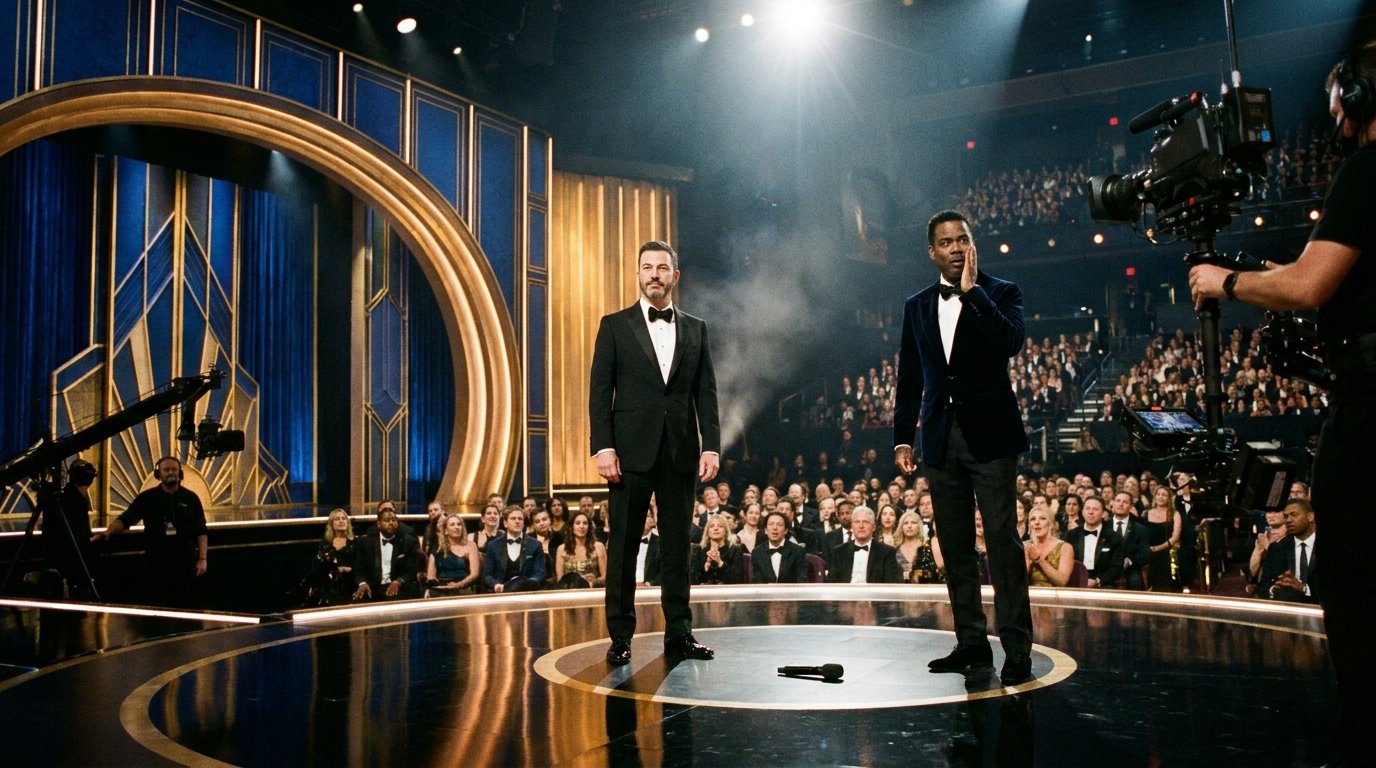
The Pantheon Awards go out live because the network insists on it. Live is why people watch. Live is also why, at 9:41 on a Sunday in February, a control room in Burbank had eleven seconds to decide something it had never had to decide before.
They chose wrong. Almost everyone agrees on that part.
Nine Forty-One
Dorian Vale was hosting for the third year.
He was fifty-one, a stand-up before he was anything else, and he had built his hosting style on the theory that the room could take it. Most years it could. His writers’ room ran every joke past a network compliance lawyer on the Thursday, and the lawyer that year had flagged four and cleared the rest.
The joke about Camille Rusk was cleared.
It was in the second block, after the first commercial break, and it was eleven words long. It referred to a medical condition — a visible one, one she had spoken about publicly exactly once, in a magazine interview eighteen months earlier, in the context of asking people to stop speculating about it.
The joke landed. The room laughed for about four seconds.
Camille Rusk, forty-three, sitting in the third row in navy silk, did not laugh. The broadcast cut to her, because the broadcast always cuts to the person, and nineteen million people watched her face do the thing a face does when it has decided not to react and is failing.
Beside her, her husband laughed.
The Four Seconds After
Adrian Rusk was forty-six and had won the award he was nominated for that night twice before.
He laughed because everybody around him was laughing and because a camera was on him, and he had spent twenty-two years in a business that trains you to laugh on camera before you have finished processing what was said.
Then he looked at his wife.
People who have studied the footage frame by frame — and a great many people have — point to the same moment. It is not the joke. It is roughly two seconds later, when Adrian Rusk stops laughing and his face changes, and he glances at the camera crane swinging back toward the stage and understands that the shot of his wife’s face has already gone out and cannot be recalled.
He stood up.
What Happened on Stage
He walked up the side steps.
The audience was still settling. A number of people in the front rows have said they assumed it was a bit — that this was a planned crossover, the sort of staged confrontation the show had done before.
Dorian Vale appears, in the footage, to think the same thing for approximately one and a half seconds.
What followed lasted less than a second and was loud enough to register on the room mics. The handheld microphone hit the stage floor and produced a feedback squeal that ran through the entire arena PA and out to nineteen million homes before the audio operator killed the channel.
Then Adrian Rusk said, at full volume and into a live open room:
“Don’t say my wife’s name again.”
He walked back down the steps and sat down.
The broadcast stayed on the wide shot for eleven seconds — the eleven seconds the control room spent deciding — and then cut to a commercial that was not scheduled to run for another eight minutes.
The Rest of the Night
The show came back.
Dorian Vale was not on stage when it did. A presenter who had been due in the fourth block came out early, delivered a category with visible difficulty, and left.
Forty minutes later, Adrian Rusk won the award he was nominated for.
He walked back up the same steps to collect it. The room gave him a standing ovation that lasted nineteen seconds, and that ovation — not the slap — is the thing that generated the following week’s actual crisis, because it went out live too, and a great many people watching at home had a strong opinion about what a room full of professionals had just applauded.
His acceptance speech was ninety seconds long. He apologised to the network, to the crew, and to the nominees whose category had been disrupted.
He did not apologise to Dorian Vale. That omission was noticed in real time, and it was still being written about four months later.
What the Network Did
Everything, and in the wrong order.
The Academy issued a statement at 11:20 that night condemning the incident, then a second at 2:40 in the morning that was materially different in tone, then a third on the Monday that contradicted the first two on the question of whether anyone had been asked to leave the building.
They had not asked him to leave. Three separate people later confirmed, on the record, that the question was raised and that nobody could establish who had the authority to decide it.
Dorian Vale declined to press charges on the Tuesday and issued a statement saying so, which contained one line that his own representatives reportedly begged him to remove: that he had been told the joke was cleared, and that he would like to know by whom.
That line ended the compliance lawyer’s career and started a defamation claim that had nothing to do with the slap at all.
What Camille Rusk Did
Nothing, for five weeks.
Then she published an essay of two thousand words, in a magazine, under her own byline, and it did not mention her husband until the eleventh paragraph.
It was about the eighteen months since her original interview: the volume of speculation about her body, the specific and repeated public comments, the fact that she had asked once and had been treated as having made herself fair game by asking.
The last section was the part that got quoted everywhere. She wrote that she had been sitting in the third row of a room where nine hundred people laughed at her, and that what had happened afterwards had not felt like protection, because she had not been asked.
She wrote that she had spent five weeks being the subject of a conversation about two men.
Eighteen Months Later
Adrian Rusk was suspended from the Academy for five years. He did not contest it.
Dorian Vale did not host again, by his own choice, and returned to touring, where his opening twenty minutes on the subject is generally regarded as the best material he has written in a decade.
The network’s insurers paid out on a business interruption claim and quietly rewrote their live broadcast policies. The compliance clearance process now involves three lawyers instead of one and a documented sign-off trail, which is the least dramatic and most consequential outcome of the entire affair.
The Rusks stayed married. Camille has said she does not discuss it and has kept to that.
The microphone was replaced. The dented original was reportedly kept by a stage manager, and when a journalist asked her about it two years later she said she had thrown it in a dumpster behind the venue the same night, because nobody needed a souvenir of the worst evening of nine hundred people’s professional lives.
What This Story Gets Right About Defamation, Broadcast Risk and Liability
The Pantheon Awards and everyone in this account are fictional. The legal exposure around a live broadcast is entirely real, and it is far broader than most viewers imagine.
A joke can still be defamatory. Comedic framing is not automatic protection. What matters is whether a reasonable audience would understand the statement as an assertion of fact. Statements about a person’s health, conduct or character are the most common danger zone, and “it was a joke” is a defence that succeeds far less often than people assume.
Live broadcast liability sits with more parties than the speaker. Networks, producers and distributors can all carry exposure for what goes out. This is why compliance clearance, delay systems and documented sign-off exist, and why the failure of that process is usually more legally significant than the incident that exposed it.
Physical contact on a stage is still assault. A celebrated setting changes nothing about the legal analysis. Criminal liability does not depend on whether the person struck presses charges; prosecutors can proceed independently, and a civil claim runs on an entirely separate track with a lower standard of proof.
Contracts carry morality and conduct clauses. Performer agreements, endorsement deals and insurance policies routinely include clauses allowing termination for conduct that brings a production into disrepute. The financial consequences of an on-stage incident are usually contractual rather than criminal, and they arrive faster.
The person spoken about often has the weakest legal position. A subject of public commentary who has not been defamed in a legally actionable way frequently has no remedy at all, regardless of the harm. Anyone in that position should take advice from a media or defamation lawyer early, because limitation periods in this area are unusually short.
Also Read: The Runway Shock: She Stopped Halfway Down the Catwalk and Took the Credit Back
Key Takeaways
- The joke was cleared by a compliance lawyer on the Thursday. That clearance, not the slap, is what generated the litigation.
- The control room’s eleven seconds of indecision cost the network more than the incident itself.
- The nineteen-second standing ovation created a bigger reputational crisis than the eleven seconds before it.
- The only person whose actual experience went undiscussed for five weeks was the person the joke was about.
Frequently Asked Questions
-
Is “The Hollywood Stage Slap” a true story?
No. Dorian Vale, Adrian Rusk, Camille Rusk and the Pantheon Awards are entirely fictional, and this account is not based on any real individual or event.
-
Can a comedian be sued for a joke?
Yes, in principle. Protection depends on whether the audience would take the statement as fact rather than opinion or obvious humour, and outcomes vary significantly between jurisdictions.
-
Is hitting someone on stage a crime even if they don’t press charges?
Generally yes. In most jurisdictions the decision to prosecute belongs to the state, not the person struck, and civil claims can proceed regardless.
-
Who is liable for what goes out on a live broadcast?
Potentially the speaker, the producer, the network and the distributor. This is why broadcast compliance processes and transmission delays exist, and why documented clearance matters so much.