The Runway Shock: She Stopped Halfway Down the Catwalk and Took the Credit Back
The Vessalo show was scheduled for 6:15 on the fourth day of Milan Fashion Week and started, as it always did, eleven minutes late.
Two hundred and forty seats. Ninety accredited photographers in the pit at the far end. A soundtrack chosen by a producer who had been paid more than the entire atelier team combined.
Everyone in that room had come to see thirty-one looks. They saw thirty.
The House
Rafael Vessalo was fifty-six and had been on the cover of things since 1998.
He had built a house on one idea and one story: that he sketched everything himself, alone, at night, in a converted chapel outside Como. It was a very good story. He told it in every interview, and journalists repeated it because he was charming and because nobody had a reason to check.
The atelier’s actual sketching was done by four people. This was not a secret inside the building and was invisible outside it.
Nadia Ferrante was twenty-nine and one of the four.
She had come in as a pattern-cutting apprentice at twenty-two, moved into design assistance at twenty-four, and had, by twenty-seven, been quietly doing the thing the house was famous for. She was also, because the house liked to be seen as one that “used its own people,” walking two or three looks per show as a model.
Both things at once. Design by day, catwalk by evening. It was framed to her as a compliment.
Look Thirty-One
The closing look was a floor-length structured coat in bone-white wool with an asymmetric shoulder seam that did something no one had seen before — it carried the entire weight of the garment along a single diagonal so the coat appeared, from the front, to have no fastening at all.
Nadia had drawn it in a notebook in February on a train to Como. She had built the first toile herself over nine days in March. She had solved the shoulder problem, which had defeated two other people, on a Sunday when the atelier was closed and she had come in anyway.
The look appeared in the show notes as Vessalo, personal archive, hand-sketched.
She had asked, twice, in writing, for a design credit in the notes. The first request received no answer. The second received a two-line reply from a studio manager explaining that the house did not issue individual credits and that this was standard.
She closed the show in the coat. She had not decided anything on the way out. That part is important, and she has repeated it in every interview since: she had not planned it.
The Hand
Rafael Vessalo came out for his bow the way he always did — late, unhurried, in a black shirt, walking up the runway toward the pit so that the photographers got him with the whole show behind him.
At the midpoint, he reached out and took his closing model’s hand.
It was a signature gesture. It read, in photographs, as generosity: the master and his muse. It had run in magazines four seasons running.
He lifted her hand and turned it slightly toward the cameras, the way you present something you own, and he said — to her, but at a volume calibrated for the front row — that this was what thirty years of instinct looked like.
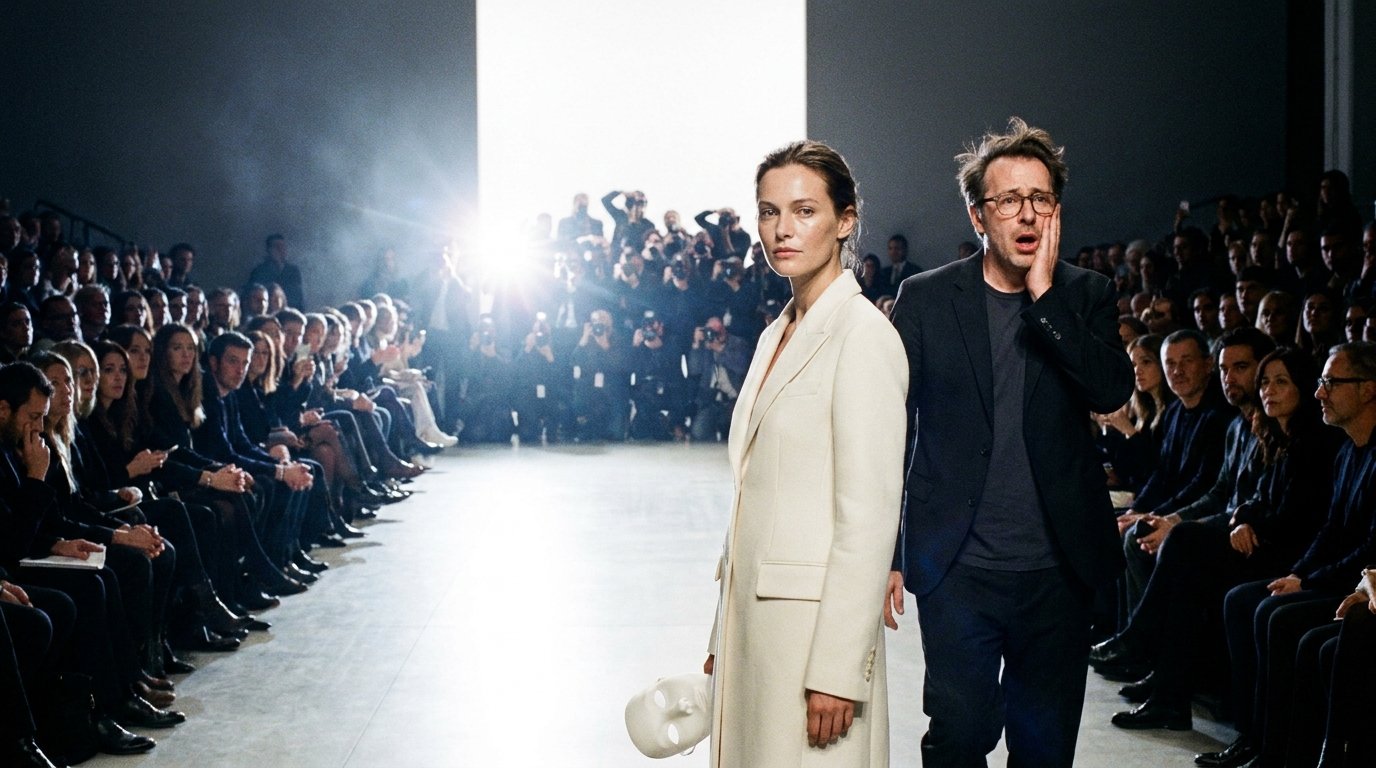
Nadia Ferrante stopped walking.
What Happened at the Midpoint
She pulled her hand out of his.
What followed lasted about one second and was extremely loud, and ninety photographers in the pit caught the aftermath of it in a single overlapping burst of flash so bright that the front row later described the room as going white.
Rafael Vessalo stood in the middle of his own runway with his hand against his face and did not move.
Nadia did not look at him. She reached up, took off the sculpted white mask that all thirty-one looks had worn, and dropped it on the floor.
“Stop,” she said. “This is my design, not yours.”
Then she walked the rest of the way to the end of the runway, at the same pace as before, and out through the exit.
The Forty Minutes That Mattered
The house’s press office issued a statement in eleven minutes. It used the word unfortunate twice and unauthorised once, and it did not deny anything, because it was written by somebody who did not yet know what could be denied.
Nadia’s response took forty minutes and was not a statement.
It was a photograph of a notebook page, posted from her own account, showing a coat sketched in pencil with the shoulder seam worked out in four attempts down the margin, and a date written in the corner in her handwriting: 11 February.
Then a second photograph. The same notebook, sixty pages later, with the shoulder solution and a note to herself in Italian.
Then a scan of an internal atelier toile record with her name in the maker field.
Then a screenshot of a two-line email from a studio manager explaining that the house did not issue individual credits.
Then nothing. She posted nothing else for six days.
What the House Did Next
Badly, is the short answer.
Vessalo’s lawyers sent Nadia a letter on the Monday citing her employment contract, which assigned all design work produced in the course of her employment to the house, and warning her about confidentiality.
They were, on the narrow legal point, largely correct. That is exactly why sending it was a catastrophe.
Because the letter said, in writing, on the house’s letterhead, that Nadia Ferrante had produced design work — which is the precise thing the house’s entire public story had spent four seasons denying.
She published the letter on the Thursday. She did not caption it.
Two department store buyers paused their orders within a week. A retrospective exhibition scheduled for Paris was postponed and then quietly cancelled. Three of the four people in the sketching team resigned within a month, and two of them gave interviews.
Eighteen Months Later
Rafael Vessalo did not lose the house. Founders rarely do.
He lost the story, which in his industry was worth considerably more. He gave one long interview in which he said that credit practices in fashion were historic and complicated, which was true, and that he had never personally claimed sole authorship, which was not.
Nadia Ferrante did not sue. She has said, repeatedly and slightly wearily, that the contract was the contract and that her lawyers told her the same thing on day one.
She launched her own label in the spring, with four people and a great deal less money than anyone assumed. The first collection had nine looks. The closing piece was a bone-white structured coat with an asymmetric shoulder seam, entirely redrawn from scratch, because she was legally unable to reproduce the original and professionally determined to prove she could do it twice.
The show notes credited every person who touched it, by name, including the pattern cutter and the two interns.
The mask stayed on the runway floor in Milan for about ninety seconds before a production assistant picked it up. It is, according to a story nobody has ever confirmed, still in a box in that building.
What This Story Gets Right About Fashion, Copyright and Credit
The Vessalo house is fiction. The legal architecture underneath it is real, and it is the reason this situation recurs in the industry every few years.
Work created by an employee usually belongs to the employer. In most jurisdictions, intellectual property produced in the course of employment is automatically assigned to the company. Designers frequently discover this only when they try to take a portfolio with them. What the contract says at signing determines everything that happens afterwards.
Credit and ownership are different things. Ownership is decided by contract and statute. Credit is a matter of negotiation and industry custom, and it is very often not written into contracts at all — which is precisely why it should be. A named credit clause costs nothing to insert and is nearly impossible to obtain later.
Fashion sits in a strange gap in copyright law. Garment shapes are often treated as functional and therefore weakly protected in many jurisdictions, while prints, patterns and surface designs receive stronger protection. Registered and unregistered design rights offer additional routes, but they run to short deadlines that expire quickly after public disclosure.
Dated evidence is the whole game. Notebooks, timestamped files, internal records, emails and toile logs are what any dispute turns on. Creators who keep contemporaneous dated records are in a fundamentally different position from those who do not, regardless of who was actually first.
A legal letter is a public document waiting to happen. Correspondence sent to assert rights can concede facts, and in a reputational dispute the concession is frequently worth more to the other side than the legal point being made. Anyone drafting one should assume it will be read by people it was never addressed to.
Also Read: The Restaurant Revenge: She Walked Into the Dining Room He Thought She’d Never Find
Key Takeaways
- Nadia Ferrante’s second-strongest evidence was a notebook. Her strongest was a letter the house sent her.
- The house was legally in the right about ownership and destroyed itself proving it.
- Two written requests for a design credit, both refused, are what made everything afterwards defensible.
- She had to redraw the coat from scratch to be allowed to make it again — and did.
Frequently Asked Questions
-
Is “The Runway Shock” a true story?
No. Rafael Vessalo, Nadia Ferrante and the Vessalo house are entirely fictional. The intellectual property principles in the explainer section are real and broadly applicable.
-
Who owns a design made by an employee?
In most jurisdictions the employer does, automatically, where the work was made in the course of employment. Freelance and contractor arrangements differ significantly and depend on what the contract says.
-
Can clothing designs be copyrighted?
Protection varies widely. Prints and surface patterns are generally protected more strongly than garment shapes, and registered or unregistered design rights may apply, usually with strict deadlines that begin running at public disclosure.
-
How can a designer protect their work before showing it?
Keep dated records, register designs where the jurisdiction allows it, negotiate credit clauses in writing before starting, and take advice from an intellectual property lawyer before publishing anything publicly, because disclosure can start clocks running.