The Restaurant Revenge: She Walked Into the Dining Room He Thought She’d Never Find
Vittorio’s has eleven tables and takes bookings six weeks out. The lighting is low enough that regulars joke about needing a torch to read the menu, which is precisely why people who want to be unseen choose it, and precisely why it is the worst possible place to be unseen.
Eleven tables. Everybody hears everything.
Table Four, 8:20 PM
Nathan Cole was forty-two and had been married for fourteen years.
He sat at table four with a woman named Sienna, who was thirty-one and worked in commercial insurance, and who was, in every way that matters, not a villain. She had been told a story eleven months earlier and had believed it, because it was a good story and he told it well.
The story was that his marriage had ended in everything but paperwork. That he and his wife lived in the same house for the children. That the lawyers were slow. That it would be finalised in the spring, and then again by the summer, and then by the autumn.
He was holding both her hands across the tablecloth when he said it.
“I’ve never been more certain of anything in my life.”
On her left hand, catching the candle, was a ring he had bought in March.
Row Eight
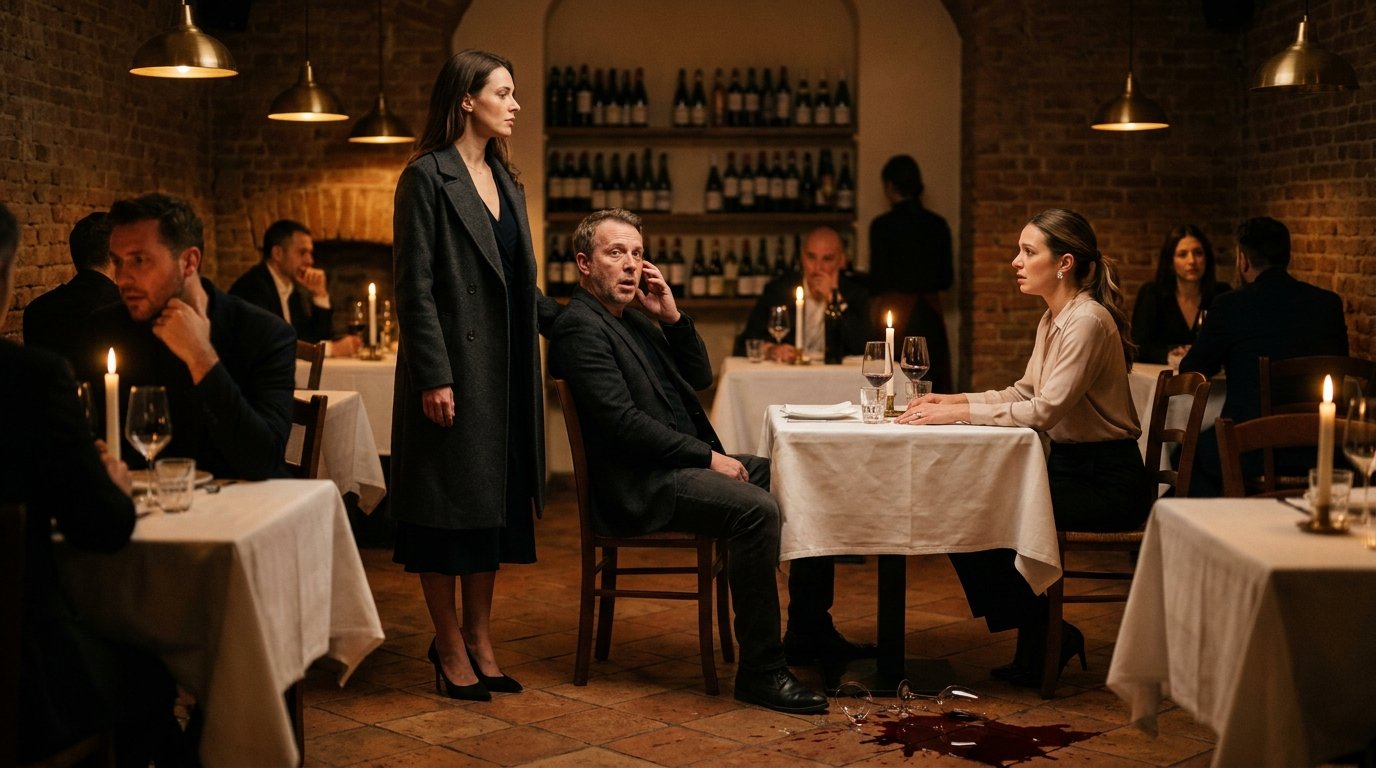
Elena Cole was forty-one and had not intended to be there.
She had spent nine weeks not intending things. Not intending to check the credit card statement in October. Not intending to notice a jeweller’s charge in March that had produced no gift she had ever received. Not intending to sit in a car outside a restaurant for twenty minutes on a Thursday and then, eventually, walk in.
She had been an events manager before the children and had a professional’s memory for rooms. She stood in the doorway for perhaps four seconds and took in everything: the eleven tables, the candles, the waiter frozen mid-pour at table seven, her husband’s hands wrapped around another woman’s hands, and the light coming off a diamond that he had bought five months earlier while telling her they could not afford to fix the boiler.
Then she crossed the room.
What Happened at Table Four
She put her hand on Nathan’s shoulder and turned him around in his chair.
What she did next was fast and loud and lasted less than a second, and every person in that restaurant heard it. His wine glass went off the edge of the table and broke on the tiles. A woman at table two put down her fork. The waiter did not move at all.
Nathan Cole sat with his hand against his cheek and said nothing, because there was nothing available to say that would have survived being said out loud in that room.
Elena did not look at him after that. She looked at Sienna.
“He is not divorced,” she said. “He is not separated. He is not living in a spare room. He lives with me, and with our daughters, who are eleven and eight, and on Sunday he took them swimming.”
Sienna’s hands were still on the table where Nathan had left them.
“Take the ring off,” Elena said. “Not for me. For you.”
The Part That Cost Him
Sienna took it off.
She did it slowly, and without any drama at all, and she set it down on the tablecloth between the candle and the bread plate, and she looked at it for a moment as if she were reading something written on it.
Then she picked up her phone.
“I need to say something,” she said, to nobody in particular and to the whole room at once. “He told me he’d been separated for two years. I have that in writing. About four hundred messages of it.”
She looked at Elena.
“I’ll send you all of it. Tonight. If you want it.”
Elena Cole, who had come into that restaurant expecting to break something and leave, stood very still for a moment.
“I want it,” she said.
The Walk Out
Here is the part people who tell this story usually leave out.
Elena did not storm out. She picked up the broken stem of the wine glass from the floor, because there were staff in that room who would otherwise have to, and she set it on the edge of the table.
She said, to the waiter, that she was sorry about the noise and the glass and that she would pay for both.
He said, quietly, that there was no charge.
Then she walked out through the front door, sat down in her car, and did not start the engine for nineteen minutes, which is the only detail in this entire account that she has ever admitted to being embarrassed about.
Nathan Cole came out eleven minutes into that nineteen. He knocked on the passenger window with one knuckle.
She did not unlock the door. She did not look at him. She held up one hand, flat against the glass, in the universal gesture that means stop, and she kept it there until he stepped back.
What Actually Ended the Marriage
Not the slap. Not the scene. Not even the ring.
It was the four hundred messages.
They arrived at 11:40 that night in a single compressed file, and Elena did not read them until Saturday, when the girls were at their grandmother’s. She read them in one sitting with a legal pad beside her, and by the end she had three pages of notes, and only one page of it was about the affair.
The other two pages were about money.
He had told Sienna about a “restructure” at work in February and what it would be worth to him. He had told her, in April, about a bonus that had never appeared in any joint account statement Elena had ever seen. He had described a savings account in some detail in June while explaining why he could not yet move out.
None of it existed on any document Elena had ever been shown.
She photographed her three pages, emailed them to herself, and on Monday morning she called a solicitor who specialised in financial remedy work and said one sentence that the solicitor later described as the most efficient opening she had ever received from a client: I think my husband has money I don’t know about, and I have four hundred messages in which he describes it.
Eighteen Months Later
The affair barely featured in the proceedings. In most jurisdictions it barely does — courts are far more interested in what a person owns than in who they had dinner with.
The non-disclosure featured enormously.
A forensic accountant was instructed. The bonus was located in ninety minutes. The savings account took slightly longer, and the “restructure” turned out to be a share allocation Nathan had valued out loud, to somebody else, at roughly four times the figure he had put on his own financial statement.
He was ordered to pay the costs of the exercise. The final settlement was not the one he had planned for in the spring, or in the summer, or in the autumn.
Elena kept the house. She fixed the boiler in November, which she reports is the single most satisfying purchase of her adult life.
Sienna sent one further message, six weeks after the restaurant, saying she was sorry and that she had not known, and asking nothing. Elena replied with two words — I know — and the two women have not spoken since, which both of them appear to regard as the correct outcome.
The restaurant kept the booking system exactly as it was.
Table four is still their best table.
What This Story Gets Right About Divorce, Evidence and Assets
The Coles are fiction. What decided their case is not, and it surprises people every year.
Adultery usually affects the settlement far less than people expect. Most modern divorce systems are no-fault, and financial outcomes are generally driven by needs, contributions and available assets rather than by who was unfaithful. The affair is rarely the expensive part.
Non-disclosure is the expensive part. Both parties are required to give full and honest financial disclosure. Understating income, hiding a bonus, or misvaluing shares is a serious breach, and courts can reopen settlements, draw adverse inferences, and order the concealing party to pay the other side’s costs.
Messages describing money are treated differently from messages describing an affair. A spouse’s own written descriptions of income or assets can be highly relevant evidence in financial proceedings. How such material was obtained matters, though, which is why it should go to a solicitor before it goes anywhere else.
Do not obtain evidence unlawfully. Accessing a spouse’s email, phone or accounts without permission can be a criminal offence in many jurisdictions and can render material unusable or expose the person who obtained it. Material voluntarily sent by a third party sits in a very different category from material taken.
Confrontation is emotionally understandable and legally unhelpful. Physical confrontation, however provoked, can result in criminal liability and can be used against a person in proceedings involving children. Anyone in this situation is far better served by documenting, dating and taking legal advice quickly.
Also Read: Gala Night Betrayal: He Raised a Glass to Twenty Years — Then a Stranger Handed Him an Envelope
Key Takeaways
- The scene at table four lasted a second. The messages sent at 11:40 that night decided everything.
- Sienna was lied to for eleven months and chose, in about ninety seconds, what to do about it.
- Courts cared very little about the affair and enormously about a bonus that never appeared on a statement.
- The most valuable thing Elena Cole did all evening was take notes on Saturday.
Frequently Asked Questions
-
Is “The Restaurant Revenge” a true story?
No. Nathan, Elena, Sienna and Vittorio’s are entirely fictional. The legal principles in the explainer section are real and broadly applicable.
-
Does cheating affect a divorce settlement?
In most no-fault jurisdictions, very little. Financial outcomes are usually determined by assets, income, needs and contributions rather than by conduct, unless the conduct itself had a financial impact.
-
Can messages from an affair be used as evidence?
Sometimes, particularly where they describe income or assets. Admissibility depends heavily on how the material was obtained, which is a question for a solicitor rather than a decision to make alone.
-
What should someone do if they suspect a spouse is hiding money?
Write down what they know with dates, preserve any documents they lawfully have access to, avoid accessing accounts without permission, and speak to a solicitor experienced in financial remedy work as early as possible.