The Uninvited Guest at the Altar: She Walked In With a Baby and Asked One Question
There were two hundred and forty guests in St. Bride’s that afternoon, and every single one of them would later claim they had felt something in the room before the doors opened.
None of them had. People only feel it afterwards.
Four in the Afternoon
The church was full of white roses. Eleven hundred of them, flown in, arranged along every pew and wound through the iron candle stands until the whole nave smelled less like a church and more like a garden in the hour before rain.
Daniel Whitmore stood at the altar in charcoal grey and held both of Cora Bennett’s hands in his.
He was thirty-four. He ran the northern half of his family’s property firm and had a reputation, entirely deserved, for being the decent one. Cora was thirty, taught architecture at the city college, and had spent the last two years being quietly warned by other people’s mothers that she was marrying above herself.
She had not cared. She had watched him fold a stranger’s shopping back into a burst bag in a supermarket car park in the rain, and had decided most of what she needed to know that day.
The priest had reached the personal vows. Daniel had written his on the back of a train ticket in October and had refused to let anyone read them.
“Cora,” he said, “you’ve spent two years asking me to be honest with you before I’m impressive. I’d rather do that for the rest of my life than anything else I can think of.”
He took a breath.
“From today, there is only you.”
Somewhere in the fourth row, a woman sniffed. Cora’s hands tightened around his.
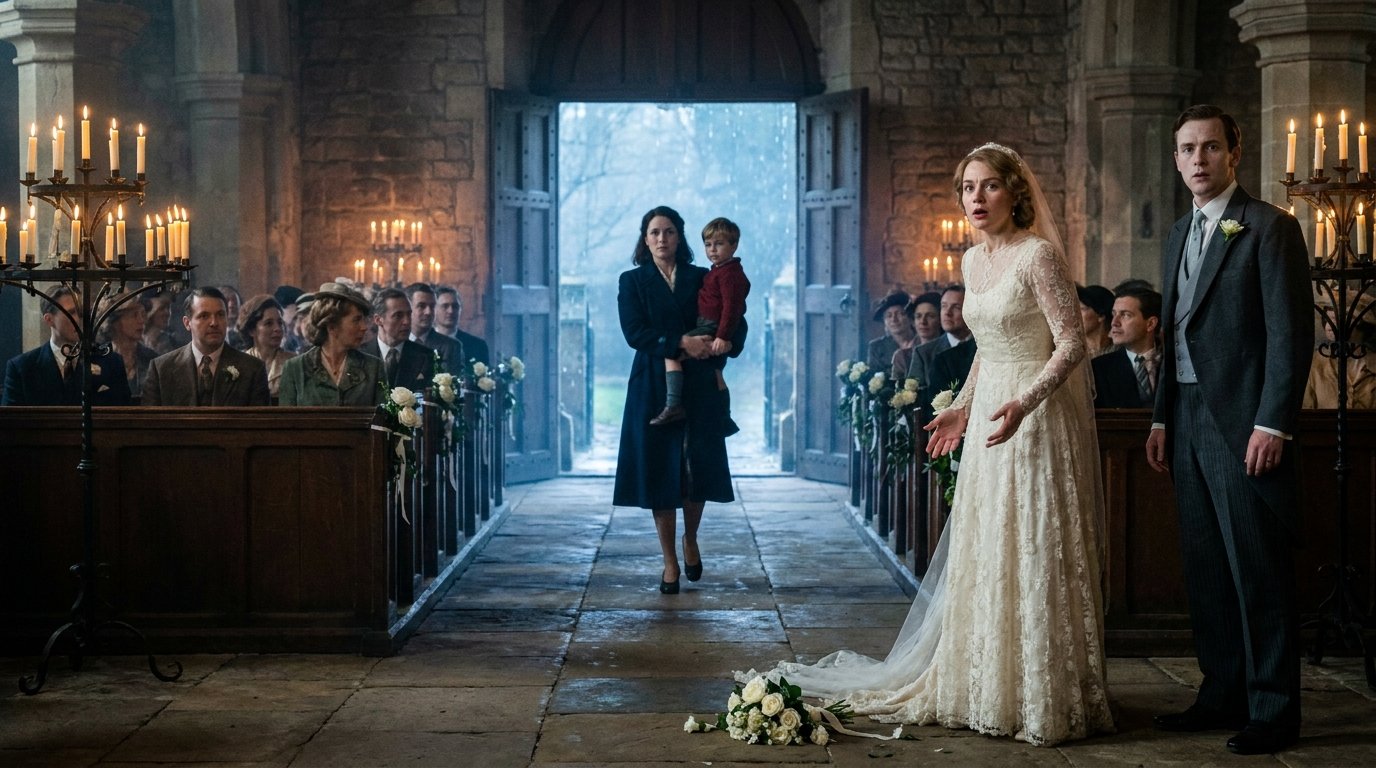
And then the west doors opened.
The Sound
They were oak and eleven feet tall and had been kept shut with an iron bar since the ceremony began. They did not creak. They came open hard, both leaves at once, and hit the stone walls behind them with a flat percussive crack that went straight up into the roof beams and came back down over everyone.
Two hundred and forty people turned at once.
A woman stood in the doorway, backlit by the grey afternoon so that for a moment she was only a shape. Then she stepped forward into the candlelight and the shape resolved into someone very ordinary: mid-twenties, dark coat, wet shoes, hair stuck to one cheek from the rain outside.
On her hip she carried a child. A boy, no more than fourteen months, in a red knitted jumper, wide awake and entirely unbothered, staring at the candles with the frank interest of someone who has never been told to be quiet in a church.
She walked up the aisle. Not fast. Not slow. She walked the way people walk when they have already imagined the walk a hundred times.
Cora’s bouquet slipped out of her fingers and struck the stone. White roses came apart across the aisle.
The woman stopped six feet from the altar.
“Stop,” she said. Her voice was not raised. It carried anyway. “Tell the bride whose child this is.”
The Silence
Daniel Whitmore did not say anything.
That was the part Cora would think about for months afterwards — not the doors, not the question, but the fact that her almost-husband stood there with his mouth slightly open and made no sound at all, and that his eyes went to the child and then, immediately and involuntarily, sideways to the front pew.
To his mother.
Vivienne Whitmore was sixty-one years old and wearing dove grey. She had not turned around when the doors opened. She was still facing the altar, chin level, hands folded in her lap, and she had gone the specific shade of white that has nothing to do with shock.
Cora Bennett looked at her fiancé. Then at the woman. Then at the front pew.
And she understood, in the order that these things are always understood, that the person in the room who was least surprised was the person who had known the longest.
What Had Actually Happened
Her name was Rosalind Vance. She was twenty-seven and worked in a dental surgery in a town ninety miles north.
She and Daniel had been together for eight months, four years earlier, in the period after his father’s death when he had more or less stopped functioning. It had ended the way those things end — badly, quietly, with him going back to the family firm and her not being asked to come.
She had found out she was pregnant eleven weeks after it ended.
She wrote to him. Twice. She called the firm’s main line and left her name and number with a receptionist. She waited.
What she received instead, on a Tuesday in March, was a visit from a woman in dove grey who arrived in a car with a driver and did not get out of it, who spoke to her through a lowered window in a supermarket car park for nine minutes, and who explained several things very calmly.
That Daniel was building something. That a child now would undo it. That there was a figure available, and that the figure was generous, and that it came with an agreement drafted by a solicitor which Rosalind should read carefully and would need to sign.
Rosalind, twenty-three years old and eight weeks from losing her flat, signed it.
She took the money. She had the baby. And she kept the agreement in a drawer for two and a half years, along with a receipt, a bank transfer record, and a copy of a letter she had written to Daniel in 2022 that had been returned to her unopened with a firm’s franking mark on the envelope.
Daniel Whitmore, who was the decent one, had never seen a single word of it.
The Bride
Here is what Cora Bennett did.
She did not scream. She did not slap anyone. She did not run down the aisle with her skirt in her fists, which is what everybody in that church was braced for and what half of them, honestly, had already begun to enjoy.
She let go of Daniel’s hands.
She stepped down off the altar in her wedding dress, crossed six feet of stone in silence, and stopped in front of Rosalind Vance and the boy in the red jumper.
“Is he yours and Daniel’s?” she asked.
“Yes.”
“Does Daniel know he exists?”
Rosalind’s mouth moved before her voice caught up with it. “He never answered me.”
Cora nodded slowly, once. Then she turned around, and looked past her fiancé, past the priest, past two hundred and forty faces, at a woman in dove grey in the front pew.
“Vivienne,” she said. “Stand up.”
What the Drawer Held
The wedding did not happen.
The reception did, in a fashion, because four hundred meals had been paid for and the hotel could not un-cook them. Perhaps sixty people went. It is remembered as the strangest evening anyone there has ever attended.
Daniel went with Rosalind and a solicitor to see the agreement the following Monday. He read all four pages twice in a room with the door closed, and then went outside and was sick in a car park, which his own solicitor later described, drily, as the most honest reaction he had witnessed in thirty years of family law.
The agreement was worth very little. Contracts that attempt to bargain away a child’s rights are not treated by the courts the way people who write them hope. But that was never really the point of it. It had worked for four years not because it was enforceable, but because a frightened twenty-three-year-old had believed it was.
There was a DNA test. It said what everyone already knew.
Vivienne Whitmore was removed from the board of the family firm in November by a vote her son called and did not speak during. She sees her grandson four times a year, supervised, at Rosalind’s insistence and with Daniel’s agreement.
The Part Nobody Expected
Cora Bennett did not go back to Daniel Whitmore that year.
She went back the year after. Slowly, and on conditions she wrote down and did not soften, and the first of them was that the boy in the red jumper was not a complication to be managed but a person to be raised.
They married in a registry office with nine people present. Rosalind Vance was one of them, because by then the two women had done something the entire wedding party had assumed impossible, which was to become genuinely fond of each other in the way of people who have survived the same weather.
The boy was two and a half. He carried nothing and was given no job and was allowed to run the length of the room twice during the ceremony.
Cora carried no bouquet. She had told Daniel, when he asked, that she had already dropped one of those, and she had noticed at the time that it had not actually been the important thing she was holding.
What This Story Gets Right About Paternity and Family Law
The Whitmores are fiction. The legal shape of what happened to Rosalind Vance is not, and it is more common than most people realise.
A parent cannot sign away a child’s rights. Private agreements in which one parent accepts a lump sum in exchange for silence, or for giving up future claims, are generally unenforceable as to the child. Child maintenance belongs to the child, not to the parent receiving it, so a parent has no authority to waive it permanently on the child’s behalf.
Paternity can be established years later. In most jurisdictions there is no short deadline for establishing parentage. DNA testing arranged through the courts is straightforward, and once parentage is established it usually carries retrospective financial consequences as well as forward-looking ones.
Prenuptial agreements do not cover children. A prenup can address property and spousal arrangements, but courts retain authority over child maintenance and child arrangements regardless of what a couple signed. This is one of the most widely misunderstood points in family law.
Pressure and imbalance matter. Agreements signed without independent legal advice, under financial distress, or under pressure from a party with far greater resources are vulnerable to challenge. Independent advice for both sides is not a formality — it is often the single factor that decides whether an agreement survives.
Discovering a hidden child before marriage changes the legal picture, not just the emotional one. Depending on the jurisdiction, concealment of a material fact before a marriage can be relevant to annulment as distinct from divorce, and it can affect financial proceedings. Anyone in that position should speak to a family law solicitor before making decisions in the days immediately afterwards.
Also Read: The Bedside Confession: His Father Was Dying, So He Reached for the Key — Then the Old Man Spoke
Key Takeaways
- The scandal in that church was four years old before the doors ever opened.
- Daniel Whitmore’s silence at the altar was not guilt. It was the moment he understood who had been protecting him.
- The agreement worked for four years because it frightened a young woman, not because it was legally sound.
- The bride’s first question was not how could you — it was does he know his son exists, and that question is why the story ends the way it does.
Frequently Asked Questions
-
Is “The Uninvited Guest at the Altar” a true story?
No. Daniel, Cora, Rosalind, Vivienne and St. Bride’s are entirely fictional. The family law principles in the explainer section are real and broadly applicable.
-
Can someone legally pay a person to stay silent about a child?
They can attempt it, but such agreements are generally unenforceable against the child’s interests. Depending on the circumstances and jurisdiction, the conduct itself may also carry legal consequences.
-
Can a wedding be legally stopped by someone objecting?
An objection during a ceremony has almost no legal force in most modern jurisdictions unless it raises a genuine legal impediment, such as an existing marriage. In practice, ceremonies are stopped by the couple, not by the objector.
-
Does a hidden child affect a divorce or annulment?
It can. Concealment of a material fact before marriage may be relevant to annulment in some jurisdictions and to financial proceedings in others. It is a fact-specific question for a family law solicitor.