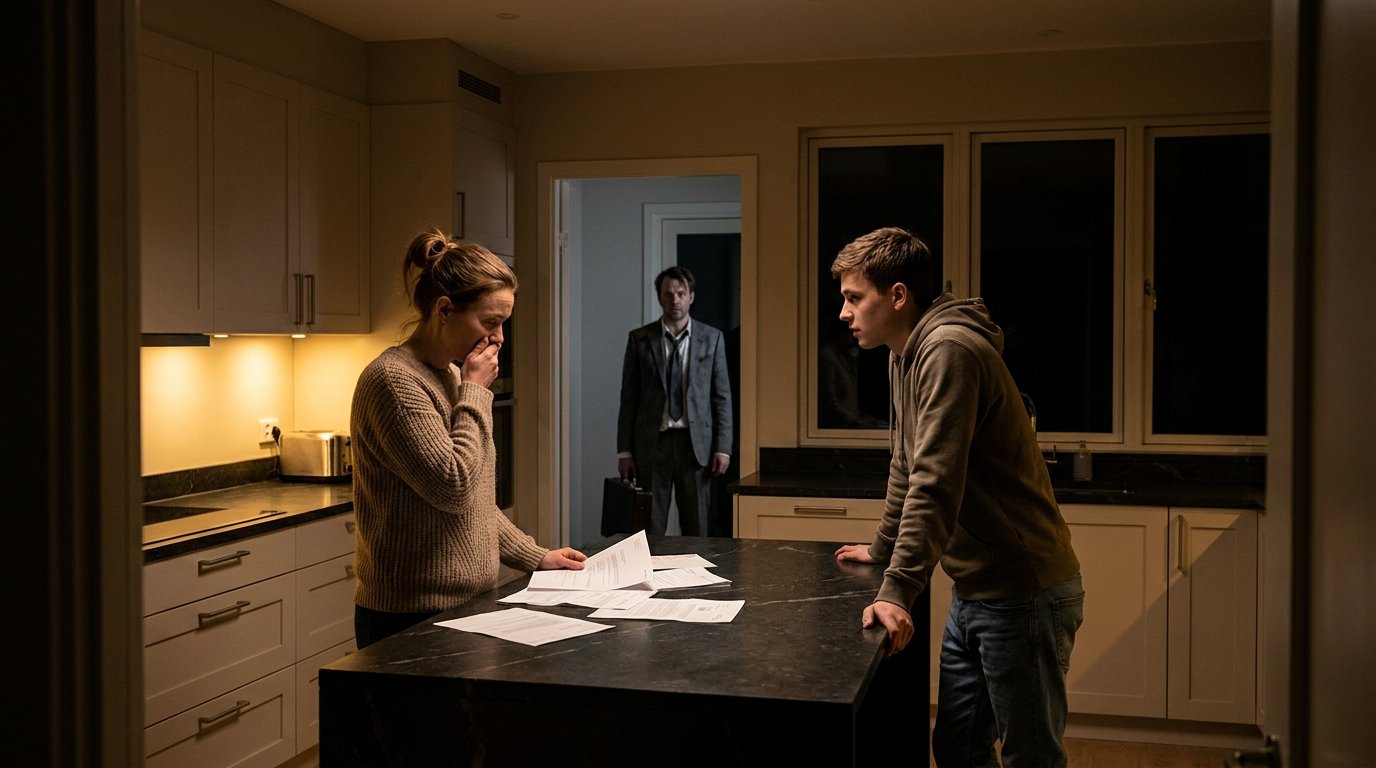
The Midnight Argument That Tested a Family’s Trust
The Damage Rarely Starts With the Guilty Person
Ask most people when a family fell apart and they will point to the day the truth came out. That is almost never the right date.
The real harm tends to happen earlier, in a stretch of time nobody talks about afterwards: the days or weeks between one person noticing something wrong and that concern finally reaching the people who could explain it. Nothing has been proven yet. Nobody has done anything irreversible. And yet this is precisely where households quietly break, because a suspicion carried alone doesn’t stay still. It grows a shape.
Rebuilding family trust, in practice, is usually a response to that stretch — not to the underlying facts at all. Plenty of families survive an actual betrayal. Fewer survive a badly delivered accusation that turned out to be wrong.
In short: how a suspicion is raised matters more than whether it was correct. Concerns held privately and delivered to one person, late, in isolation, leave damage that outlasts the truth. The same concern brought openly to everyone who has access to the facts is usually settled within days, with the relationships intact.
The walkthrough below is illustrative. The people are invented and the specifics are constructed to make the stages visible. The sequence itself is one that plays out in households on every continent, in every income bracket, in nuclear families and multigenerational ones alike.
The Scenario: A Kitchen, Very Late
Robert is in his fifties, remarried for four years, and away for work often enough that the household runs without him for stretches. His wife Elena is in her thirties. Leo, his son from an earlier marriage, is nineteen and studying while living at home.
Some weeks before the night in question, Elena noticed a pattern in the household accounts. Money leaving in small, unremarkable amounts — never large enough on any single line to draw attention, but adding up over four months to a figure that could not be dismissed.
She began printing the statements. She marked the entries she couldn’t account for. And she told nobody at all.
Stage One: The Weeks Nobody Saw
Her reasons were entirely reasonable, which is what makes this stage so common.
She wasn’t sure. She didn’t want to accuse someone wrongly and never be forgiven for it. And underneath both of those, there was a quieter calculation: as the second wife in a household with a grown stepson, she suspected that raising a money problem would be heard as her making trouble, positioning herself, or looking for a reason to push someone out.
So she gathered instead. Week after week, alone.
The trouble is that certainty built in private is unusually unreliable. When you sit with the same set of facts for long enough without anyone challenging your reading of them, you don’t get closer to the truth — you build a theory, and then every new detail gets filed as support. The gaps fill themselves in. By the end of three weeks, Elena was not undecided anymore, and nothing had actually been established.
What this stage teaches: the moment you begin quietly collecting proof about someone you live with, a decision has already been made. It feels like restraint. It functions as a verdict being drafted in advance.
Stage Two: The Conversation Neither of Them Chose
Leo came downstairs for water somewhere past one in the morning and found her at the kitchen island with the papers laid out under the lamp.
She told him she had been going through his father’s accounts. She said money had been leaving the household for months. She said it wasn’t her, gave the total, gave the timeframe, and observed that only three people had access.
She never once said I think it was you. She didn’t need to. Two of the three people with access were standing in that kitchen, and only one of them had spent three weeks assembling the file.
What kept the night from becoming permanent was Leo’s response, and it was not the obvious one. He didn’t defend himself, didn’t raise his voice, didn’t walk out. He put the glass down, pulled out the chair opposite hers, sat, and made her state the accusation properly — out loud, in a full sentence, to his face.
What this stage teaches: an implied accusation is harder to survive than a direct one, because there is nothing to answer. If it’s aimed at you, the most useful thing you can do is calmly bring it into the open. If you’re the one making it, say the actual sentence or don’t begin the conversation at all.
Stage Three: The Door Opens
Robert returned a day earlier than expected and walked into a hallway to find his wife and his son at the kitchen island at one in the morning, surrounded by printed statements and a red pen.
When his anger came, it wasn’t about the money.
It was about the arrangement he had just discovered — that a serious accusation had existed in his home for weeks without reaching him, and had then been delivered to a nineteen-year-old, alone, in the dark, by the adult holding the evidence. He was the only person who could have resolved it in five minutes. He was the only person who had not been told.
What this stage teaches: in a household with a step parent, the biological parent isn’t a spectator to conflict between their partner and their child. They are the load-bearing structure of it. Any concern serious enough to gather proof about is serious enough to reach them first, and every route that goes around them makes the home less stable than it was.
Stage Four: Everyone at the Same Table
They stayed up until nearly four, all three of them, working through the statements line by line with the same documents in front of all of them.
The withdrawals belonged to neither Elena nor Leo. Every one of them traced back to a secondary card Robert had issued to a business associate two years earlier for company expenses — and had never cancelled, never reviewed, and largely forgotten existed.
Under three hours in a room together produced an answer that three weeks of solitary certainty had pointed in exactly the wrong direction.
Three weeks of private evidence produced the wrong conclusion. Three hours of shared evidence produced the right one.
What this stage teaches: the shortest path to the truth is nearly always the widest one. Households that solve problems with everyone present consistently outperform households where one person investigates and then presents findings, because the second version has no error correction in it anywhere.
Stage Five: What Was Actually Broken
The financial side followed the ordinary course. The card was stopped. Professional advice was taken. The process ran for months and ultimately cost more in time and fees than the original amount ever represented.
The family side was more delicate, and it did not resolve on its own.
For three weeks, Elena had privately believed her husband’s son was stealing from him. Leo knew that now, and no accounting result could unknow it. Being cleared by the numbers is not the same as being trusted.
What repaired it was that she apologised properly — out loud, in front of Robert, without the qualifier people reach for automatically. No I never really believed it was you. No I just had to be sure. She said what she had thought and that she had been wrong to think it that way.
And Leo took it briefly and let it end there, which is its own kind of skill and a rarer one than most people admit.
What this stage teaches: repairing a wrongful suspicion requires the apology to be at least as public as the suspicion was private. A hedged apology delivered quietly leaves the accusation standing in the room permanently.
Why This Pattern Travels So Well
The scenario is set in one kitchen, but the mechanics are close to universal, and they show up wherever households pool resources and share space.
In multigenerational homes, a daughter-in-law or son-in-law who notices something wrong faces the same calculation Elena did — that raising it will be read as a challenge to their place in the family rather than a legitimate concern. In households supported by relatives working abroad, money moves between people who rarely see each other, and the person managing it locally is structurally exposed to suspicion they cannot easily disprove. In families where an older relative has handed financial control to one adult child, siblings often begin collecting evidence privately for exactly the reasons Elena did, and reach exactly the same kind of wrong answer.
The variable across all of these isn’t culture, income, or how the family is structured. It’s whether the household has a habit of raising serious things openly, or a habit of raising them sideways.
That habit is almost always established long before it is tested.
What To Do Next
- Agree the rule while nothing is wrong. Serious concerns — money, honesty, safety — get raised with all the relevant adults present. Rules set during a crisis are never followed; rules set on an ordinary evening usually are.
- Put a limit on private evidence-gathering. If something has bothered you for more than a few days, treat that as the signal to speak, not as a reason to keep collecting. The quality of your judgement is falling, not rising.
- Audit the mechanics before you audit the people. Forgotten cards, dormant authorisations, standing payments and shared logins explain far more unexplained household spending than relatives do, and they cost nothing to check.
- If you have already accused someone wrongly, apologise at the volume you accused. Same room, same people, no qualifiers attached.
- Never raise something serious after ten at night. Exhaustion changes tone, and nothing said at one in the morning arrives the way it was meant, for anyone in the room.
The Night in Summary
| Stage | What happened | What it cost |
|---|---|---|
| The weeks nobody saw | Evidence gathered alone | Private certainty hardened around a wrong conclusion |
| The late confrontation | Suspicion implied rather than stated | Real damage to a relationship over something untrue |
| The father’s return | Everyone finally in one room | Anger — and the first honest moment of the night |
| The shared review | Three hours, three people, one set of papers | The actual answer |
| The aftermath | A public apology, briefly accepted | Trust repairable, though not automatically |
Key Takeaways
Rebuilding family trust responds to process far more than to facts. Investigation carried out alone produces confident, wrong conclusions. Blended and extended households are more exposed to this because the person noticing has genuine reasons to stay quiet, and the person suspected often half-expects it already. The most protective thing any family can build is a shared understanding, agreed in advance, that serious matters are raised in front of everyone — in daylight, at a table, with the people who can actually answer them in the room.
FAQ
What should I do if I think a family member is taking money?
Examine the mechanics before you consider the people. Dormant cards, forgotten authorisations, automatic payments and shared account access explain the majority of unexplained household spending. If the gap survives that check, raise it with all the relevant adults together rather than approaching one person alone.
Is it wrong to look into something before saying anything?
Confirming basic facts is sensible and takes an evening. Weeks of solitary collection is a different activity, and it reliably produces overconfidence rather than clarity.
How do you apologise properly for a wrongful accusation?
Directly, in front of the same people who witnessed the suspicion, and without softening it into a misunderstanding. A qualified apology leaves the accusation partly intact and makes recovery slower.
Should a step parent raise a concern about a stepchild on their own?
Better not to. Bringing it to the biological parent first, and raising it together, lets it be heard as a household matter rather than a step parent’s complaint — which is how it will otherwise land, however fairly it was meant.
Can a relationship recover from being falsely suspected?
Usually, provided it is named openly rather than allowed to fade. What prevents recovery is everyone agreeing, silently, to behave as though it never quite happened.
How can a family avoid this situation altogether?
By deciding, during a calm week, that serious concerns get raised with everyone present. That single habit removes almost all of the conditions this scenario depends on.