A note on the road
The state trooper who came to my door at 2:40 in the morning said the road had been dry. He said it twice, like he was apologising for it.
Peter had gone off Route 9 at the bend past the quarry, through the guardrail, forty feet down into the trees. No skid marks. No other vehicle. A clear November night, no ice, no rain, a man who had driven that road every working day for eleven years.
I remember asking the trooper whether he had suffered. I remember him saying no, ma’am, it would have been quick, and I remember thinking that everybody says that, whether it is true or not.
What I did not know, standing in my doorway in Peter’s old flannel robe, was that in nineteen days I would be sitting across a table from a woman who thought I had killed him.
The letter that arrived on a Tuesday
Grief has an administration department. Nobody warns you about that part.
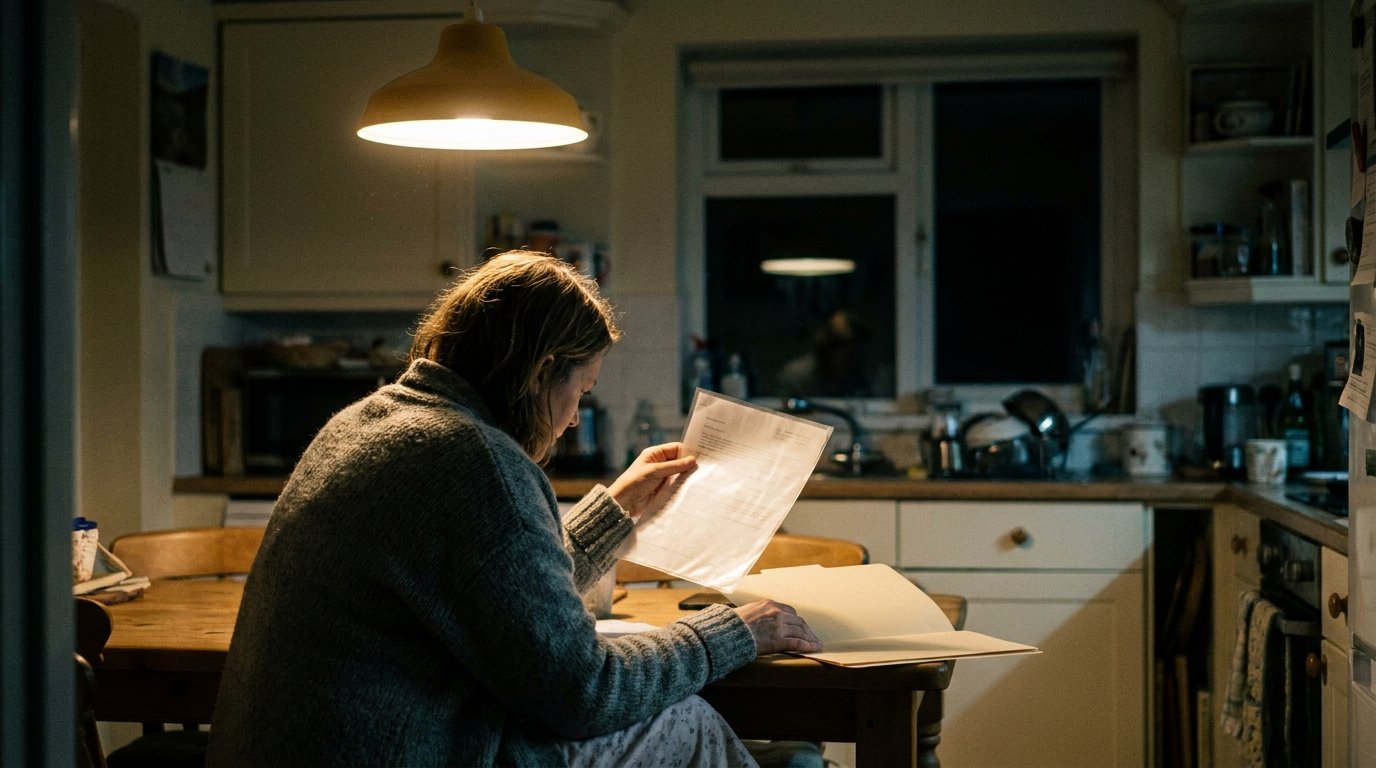
There were forms for the funeral home and forms for the county. There was a man from the bank who called me “Mrs. Doyle” in a voice so soft I wanted to scream. And on the second Tuesday, there was a letter from an insurance company I had never heard of, addressed to me, informing me that the death benefit claim on policy number 4471-90B had been placed under routine review.
I read it three times before the sentence made sense.
I did not know about any policy.
I called the number. A pleasant woman confirmed it: a term life policy in Peter’s name, seven hundred and fifty thousand dollars, purchased on the fourteenth of October. Twenty-two days before he went through that guardrail.
“Ma’am,” she said, “because the policy is inside the contestability period, an investigator has been assigned. Someone will be in touch.”
Twenty-two days. I sat down on the kitchen floor with the phone still in my hand and the letter on my knees, and for the first time since the trooper came, I did not cry.
Marla Quinn
The investigator’s name was Marla Quinn and she did not look like an investigator. She looked like somebody’s aunt, cardigan and reading glasses, a folder she opened slowly as if she were reluctant about the whole business.
She explained the contestability period. In the first two years, an insurer can look into everything — the application, the medical history, the manner of death. She explained it kindly. Then she asked me where I had been on the night of November the sixth, and the kindness sat in the room like a piece of furniture nobody was using.
I told her I had been home. Alone. Peter had left after dinner to see about a job.
“What job?”
I did not know. He had not said. He had put on his jacket and told me he would not be long, and he had touched the back of my neck the way he did, and that was the last of it.
She wrote that down. Then she asked whether I was aware that our joint savings account had been emptied in July.
I said that was not possible.
She turned the folder around so I could see. Forty-one thousand dollars, withdrawn over nine days in amounts under ten thousand. Every one of them Peter.
“Mrs. Doyle,” she said, “I’m going to ask you something and I’d like you to think before you answer. Was your husband in any kind of trouble?”
What was in the shoebox
That night I went through the house the way you do when a thing has already been taken from you and you are looking for it anyway.
I found it in the garage, in a shoebox on the shelf above his tool chest, underneath a stack of receipts for a job he finished in 2019.
A phone. Not his phone. A cheap one, the kind you buy at a gas station, with eleven calls on it and no contacts saved.
Nine of the calls were to the same number. I sat on the cold concrete floor and I pressed it and I listened to it ring, and a man picked up and said, “Pete? Pete, is that you?”
It was Danny. Peter’s brother.
The brother
Danny came the next evening and stood in my kitchen and would not sit down.
He had opened a business two years ago. Landscaping equipment, a warehouse, a lease he could not carry. Peter had co-signed it, because Peter co-signed things, because Peter had a way of believing that people would rise to whatever you trusted them with.
When the bank said no to the second loan, Danny had gone somewhere else. He was vague about where. He said the word “private” and would not look at me.
“They came here,” he said finally.
I said what.
“In August. When you were at work. They came to the house, Rachel.”
I thought about August. I thought about coming home one evening and finding Peter sitting on the porch step in the dark, not doing anything, just sitting, and how he had said he was tired, and how I had believed him because it was easier than the alternative.
Forty-one thousand dollars. Nine withdrawals. Under ten thousand each, so the bank would not flag them.
He had paid them and he had not told me, and then three weeks before he died he had gone and bought a policy on his own life.
The thing that did not fit
Marla Quinn called me on a Thursday.
“I want to show you something,” she said. “Can you come in?”
The folder was thicker now. She laid out three photographs of the rear quarter panel of Peter’s truck, taken at the salvage yard, and on the second one she tapped a mark with her pen. A scuff. A long grey-black smear along the wheel arch that I would not have looked at twice.
“That’s transfer,” she said. “Paint from another vehicle. It’s underneath the damage from the guardrail, which means it was there first.”
I did not understand for a moment. And then I did, and the room went very quiet and very far away.
“Someone hit him,” I said.
“Someone made contact with his vehicle before he left the road. The state police have reopened it.” She took her glasses off. “Mrs. Doyle, I need to tell you the other thing now, and I need you to hear all of it before you say anything.”
The beneficiary
The policy had been changed.
On the thirty-first of October, six days before he died, Peter had contacted the insurer and altered the beneficiary designation. It was no longer me.
I heard her say it and something in my chest simply stopped working. For eleven seconds I sat there and understood that my husband had spent the last month of his life lying to me, and that I had no idea at all who he had been.
Then Marla Quinn said, “The beneficiary is an irrevocable trust. It was established the same week. You are the sole beneficiary of that trust.”
I said I did not understand.
“A death benefit paid directly to a spouse is a straightforward asset,” she said. “It can be attached. If someone believed your husband owed them money, they could go after it, and in your position you would likely have paid it just to make them stop.” She closed the folder. “Money in a properly structured irrevocable trust is much harder to reach. He was told that by somebody who knew what they were doing. He paid a lawyer in Millbrook four hundred dollars in cash for forty minutes of advice on the twenty-ninth of October.”
“He was hiding it,” I said. “From them.”
“He was protecting it,” she said. “For you.”
The last nineteen days of Peter Doyle
Here is what I have been able to put together, in the two years since, from the trial and from what Danny finally said under oath with his hands shaking on the rail.
Peter paid the forty-one thousand in July and it was not enough. In October they told him what the rest would be and he understood, in whatever way a man understands such a thing, that he was not going to be able to pay it and that they were not going to stop coming to his house.
So he did the only arithmetic available to him. On the fourteenth he bought a policy. On the twenty-ninth he sat in a strip-mall office in Millbrook and asked a stranger how to make money impossible to take. On the thirty-first he signed the trust. And on the sixth of November he told me he had a job to see about, and he put his jacket on, and he touched the back of my neck.
He was not planning to die. I need that written down somewhere, so I have written it here. He had a claim ticket in his wallet for a jacket he had left at the cleaner’s. Nobody collects a jacket they do not intend to wear.
But he knew what he was driving toward, and he made sure that when it came, it would find the door already locked.
Danny had told them where Peter would be that night. He says he did not know what they intended. He said it eleven times on the stand and I watched the jury not believe him.
Also Read: Rebuilding Family Trust: The Midnight Argument That Tested Us
What I have now
The claim was paid in March, into the trust, fourteen months after that trooper stood in my doorway apologising for the weather.
I have not spent much of it. It sits there doing what he wanted it to do, which is to sit there, out of anyone’s reach.
People say he should have told me. They say it gently, the way you say a thing you have decided is true. And they are right — I would have sold the house, I would have gone to the police in July, I would have done something loud and stupid and possibly it would have worked.
But I have thought about it for two years now, and I have come to believe he did tell me. Not in words. In forty minutes with a lawyer in a strip mall he could not afford. In a cheap phone in a shoebox so that nothing would ever come to my number. In a signature on the thirty-first of October, six days before the road that was dry.
He spent the last three weeks of his life building a wall between me and the thing that was coming for him, and then he went out to meet it alone so that it would not come here.
I would rather have him. I want to be very clear about that. Every single morning, I would rather have him.
But I have never in my life been loved like that, and I do not expect to be again.