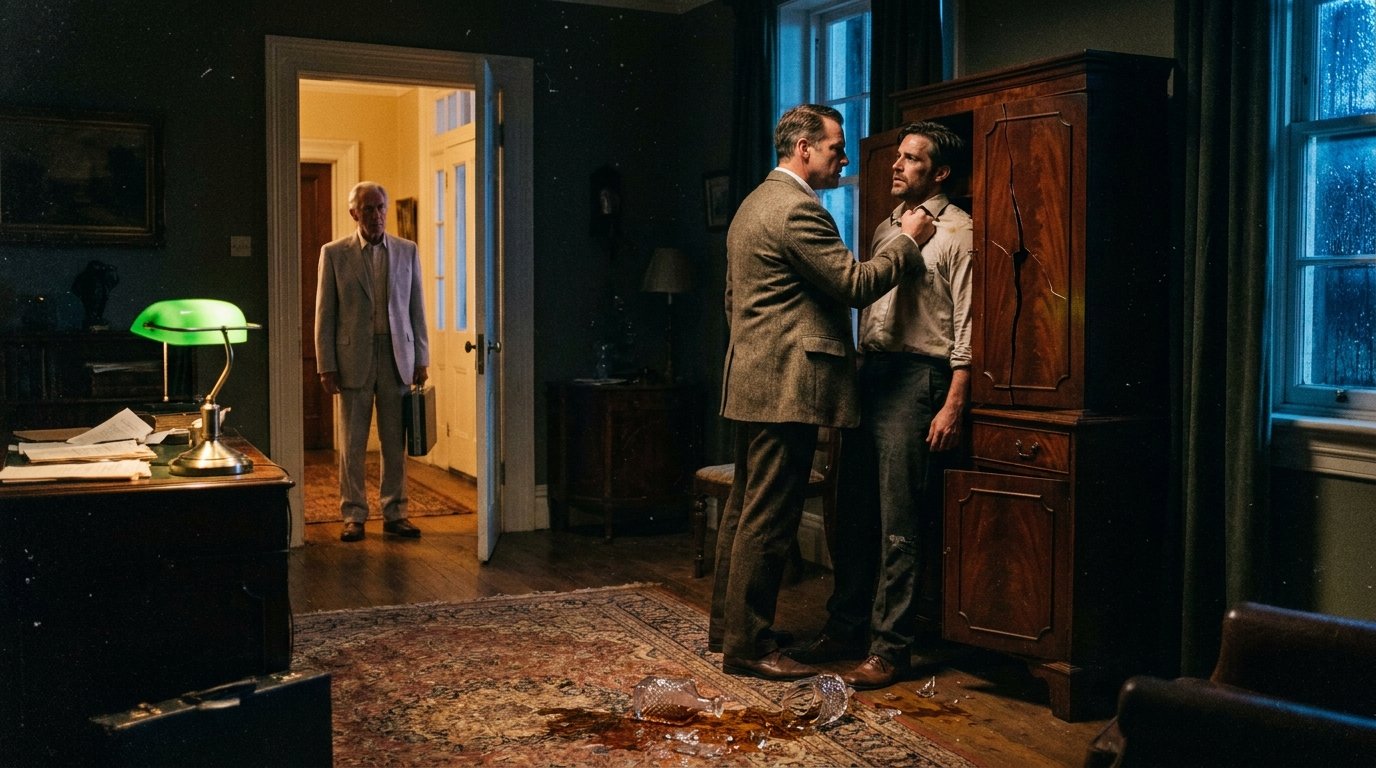
The Ashford house had survived two wars, one fire, and four generations of quiet arguments. It did not survive that Tuesday.
The Study, 9:40 PM
Harold Ashford had been dead for eleven days. His sons had waited nine of them before opening his study.
Julian Ashford, forty-four, stood at the desk with his sleeves pushed to the elbow, a folder open in front of him. He had run his father’s construction firm for six years and had convinced himself somewhere along the way that running it and owning it were the same thing.
Everett, thirty-eight, stood across from him. He had not lived in this house since he was twenty-two. He had come back for a funeral and stayed for a folder.
“You had the accountant in here on Friday,” Everett said. “Don’t insult me by pretending you didn’t.”
“Someone had to keep the payroll moving.”
“Payroll.” Everett laughed once, without any humour in it. “The payroll doesn’t need the deed to the north property, Julian. The payroll doesn’t need Dad’s signature page missing from a file that has every other page in it.”
Julian’s hand flattened on the folder. “Say what you’re actually saying.”
“I’m saying you moved something.”
When the Argument Stopped Being an Argument
It is a strange thing about brothers. They can carry a grievance for twenty years without once raising their voices, and then lose the whole thing in ninety seconds.
Everett reached for the folder. Julian pulled it back. Everett reached again, and his hand closed on his brother’s wrist, and after that it was no longer about paper.
They went sideways into the mahogany cabinet that had stood against the study’s east wall since 1961. The doors cracked. The top shelf tilted. And their father’s crystal decanter — the one he had poured from exactly twice a year, on his wedding anniversary and on the anniversary of the day the company survived its first near-collapse — slid off the edge and hit the floor.
It did not bounce. It burst.
Both men stopped. That is what silence does when it arrives late.
Julian was still holding a fistful of his brother’s collar. Everett’s shoulder was against the broken cabinet door. Amber liquid was spreading across the rug in a shape neither of them would ever be able to forget, and somewhere in that spreading shape was thirty years of a man’s small, private celebrations.
Then the study door opened.
The Man in the Silver Suit
He did not knock. He had not knocked in this house since 1988.
Alistair Crane was seventy-nine years old and had been Harold Ashford’s attorney for forty-one of those years. He wore a pale silver suit, the same cut he had worn to three Ashford weddings and one Ashford funeral, and he carried a slim leather case under his left arm.
He looked at the broken cabinet. He looked at the glass on the rug. He looked at the two grown men standing in the wreckage of their father’s favourite room with their hands still on each other.
He did not raise his voice.
“Stop this,” he said. “Neither of you is entitled to this estate.”
The Eight Words
Julian let go of his brother’s collar. Everett straightened slowly.
“That’s not funny, Alistair,” Julian said.
“It isn’t intended to be.”
Crane crossed the room, stepped around the glass with the care of a man who had known that decanter personally, and set his case on the desk. He opened it. Inside were two documents and a small sealed envelope.
“Your father restructured his holdings in March,” he said. “Not his will. His holdings. There is a difference, and it is the difference that matters tonight.”
“Restructured them how?” Everett asked.
“He moved the house, the land, the shares in the firm and the accounts into a trust. He was the trustee while he lived. I am the trustee now.” Crane looked up. “A will passes what a man owns at the moment he dies. In March, your father arranged to own almost nothing at the moment he died.”
Julian sat down. He did not choose to; his legs made the decision.
“Then who’s the beneficiary?”
The Third Name
Crane took out the second document and turned it so both men could see the page.
There was one name on it. Neither brother had said it aloud in eleven years.
“Claire,” Everett said.
“Claire Ashford is deceased,” Julian said flatly. “She died in 2015.”
“Your sister died in 2015,” Crane agreed. “Her daughter did not.”
The room did the thing rooms do when the floor moves.
“Claire had a daughter eight months before she died,” Crane went on. “She was nineteen. Your father had already cut her off — that was his decision, and he lived with it badly. The child was raised by her father’s family in Portland. Her name is Nora. She is eleven years old.”
“He never told us,” Julian said.
“He never told anyone. He told me, because a man must tell his lawyer or he cannot do anything at all.” Crane closed the case. “He found her in 2023. He did not contact her. He sat outside a school for two hours and then drove home and called me that night and asked me how a man makes something right when he is not owed the chance to.”
What the Father Wrote
The sealed envelope had one line on the front in Harold Ashford’s handwriting: For my sons, after they have finished.
Julian read it first, then handed it to Everett without a word.
Their father had written it in March, the same week he signed the trust. He wrote that he knew exactly how the two of them would behave in that study. He wrote that he had watched them circle each other for a decade and had said nothing, because saying something would have required him to admit what he had done to their sister first.
He wrote that he was not punishing them. The firm’s operating shares were left in a separate arrangement — both brothers kept their positions, their salaries, their seats. What he had taken away was the thing they had been fighting over: the assumption.
The last line was four words long.
I chose her instead.
The Rug
Crane left at eleven. He shook both their hands at the door, because he was that kind of man, and he told them that Nora would be informed by her guardians when she turned eighteen and not a day before, and that he intended to live long enough to do it himself.
Julian and Everett stayed in the study.
Somewhere around midnight, without discussing it, they got down on the floor together and started picking the glass out of the rug, piece by piece, the way you do when the thing is already broken and you are only trying to make sure nobody walks through it later and gets hurt.
Neither of them mentioned the folder again.
What This Story Gets Right About Real Estate Disputes
The twist in the Ashford study is fiction, but the legal mechanism behind it is not. Families are surprised by this exact scenario every year, and the confusion almost always comes from the same place: people assume a will controls everything a person owned. It does not.
A will only moves what you still own when you die. Assets placed into a properly funded living trust during your lifetime are already owned by the trust, so they pass outside the will — and outside probate entirely. This is why estate planning attorneys talk so much about “funding” a trust; an unfunded trust is a document that controls nothing.
Probate is public, trusts usually are not. When an estate goes through probate, the filings generally become part of the public record, which is how heirs sometimes learn about assets and beneficiaries for the first time. A trust administration is typically handled privately by the trustee, which is exactly why people who want to avoid a family fight choose one.
Beneficiary designations beat both. Life insurance payouts, retirement accounts and payable-on-death bank accounts go to whoever is named on the form, no matter what the will says. Outdated designations are one of the most common and most expensive mistakes in inheritance planning.
“No-contest” clauses raise the cost of fighting. Many estate plans include a clause stating that an heir who challenges the plan and loses forfeits whatever they were left. It doesn’t make litigation impossible, but it makes a lawsuit a genuinely dangerous bet.
If you believe something is wrong, the clock is short. Deadlines to contest a will or trust are measured in months, not years, and they vary by jurisdiction. Anyone in a real dispute should speak to a licensed estate or probate attorney early, because the strongest cases are usually lost on timing rather than on merit.
Also Read: The Policy My Husband Took Out Three Weeks Before He Died
Key Takeaways
- Julian and Everett destroyed their father’s study over a folder that had already stopped mattering in March.
- Harold Ashford used a living trust, not a will, which is why the estate never reached either son.
- The real inheritance dispute in this family began eleven years earlier, when a nineteen-year-old daughter was cut off.
- The only person who knew the whole truth was the family attorney — because someone always has to.
Frequently Asked Questions
-
Is “The Secret Inheritance” a true story?
No. The Ashford family, the estate and every character in it are fictional. The legal framework described in the explainer section is real and generally applicable.
-
Can a will be overridden by a trust?
In practice, yes. Assets transferred into a trust during a person’s lifetime are no longer part of their personal estate, so the will has nothing left to distribute. This is the single most misunderstood point in inheritance planning.
-
Can a grandchild inherit ahead of the children?
Yes. A person is generally free to leave their property to whomever they choose, including skipping a generation, unless a specific legal protection applies in their jurisdiction.
-
What should someone do if they suspect a will was changed unfairly?
Gather documentation, avoid confrontation, and consult a probate or estate litigation attorney immediately, because the window to file a challenge is limited and closes fast.